
Sermon preached at St Margaret of Antioch, Toxteth, Christmas Eve, 2025
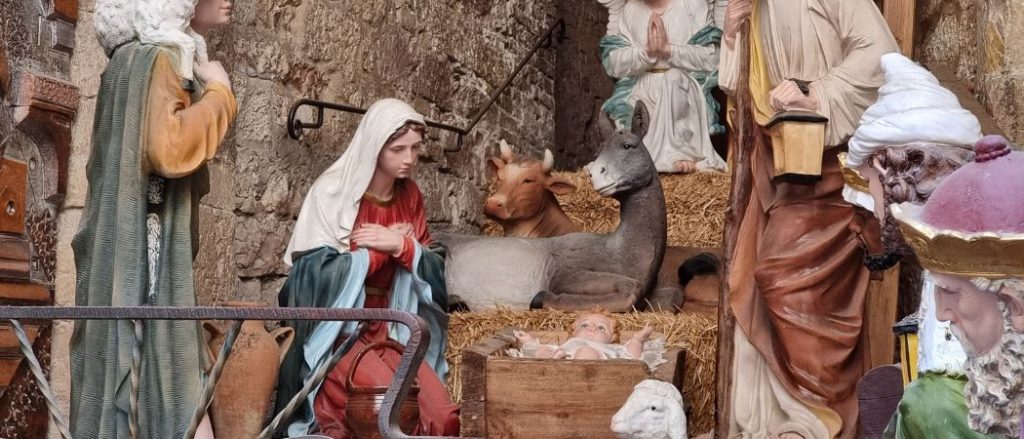
We have waited through bleak December weather. We have endured the icy winds and persevered through ever-darker nights. But these last few evenings the dusk has come just a little later, and there is a faint hope of something better on the horizon.
‘The dawn from on high shall break upon us,’ the father of John the Baptist says, breaking his silence to announce a light that will ‘shine on those who dwell in darkness and the shadow of death’ and ‘guide our feet into the way of peace.’
Centuries earlier the prophet Isaiah put it this way: ‘The people who walked in darkness have seen a great light; those who lived in a land of deep darkness—on them light has shined.’
Tonight there are rumours that the dawn approaches. A babe is born in Bethlehem; a child is given to us.
Who are the ‘us,’ for whom this child appears?
Not the proud, because the proud don’t realise they are in need of the wonderful counsellor of whom the prophet speaks. He is not here for those convinced of their own wisdom. He has nothing to offer the smug and the self-satisfied, those confident in their own standing. And so this child is not born to Caesar; nor is he born to a king in a palace. Instead, he comes to the oppressed, the underdogs, to those who know their need for justice and righteousness. He does not come to the powerful and the wealthy, but instead to an ordinary peasant family, a young woman and her carpenter husband, living under Roman occupation and forced to up sticks from their home town of Nazareth at the behest of the emperor. In such circumstances the baby must make his bed in a manger.
And who is this child? Isaiah tells us this, too: He is called mighty God.
Imagine, the Divine One who belongs in the realm of angels and archangels—God of God and light of light, as the famous carol says—embraces the virgin Mary’s womb, humbling himself to be laid among straw in an animal’s feeding trough.
The poet John Betjeman wrote:
And is it true? And is it true,
This most tremendous tale of all,
Seen in a stained-glass window’s hue,
A Baby in an ox’s stall?
The Maker of the stars and sea
Become a Child on earth for me?
And having been made flesh, to whom did God send his angels to announce this birth? To the rich? To the honourable? To those with influence? No; rather to the most despised. Shepherds were poor, they were dirty; like bandits and spies they were shifty and not be trusted, because they moved around by night when the respectable were indoors.
Later God will reveal his Son to wise men and kings, but tonight the first guests to be welcomed at the manger will be outsiders.
Are you despised? Are you viewed with suspicion? Jesus Christ has come not for those who consider themselves success stories, but for life’s losers. He is born for those who know they need God; those who feel the darkness deeply and long for the light to break through. He is born for those who, like the tax collector in the parable, look only down and prayerfully beg of God: Be merciful to me, a sinner. Be kind to me, God, because I need kindness. The Pharisee who proudly boasts of his accomplishments and thanks God that he is not like the thieves, the rogues, the adulterers and the tax collectors will never know the child of Bethlehem, because he does not recognise his need of a saviour; he will never think of looking for God in the poverty of a manger.
Tonight, Christ makes his home with the humble. With those who will say: I need forgiveness; I need a peace that the world cannot give. Muslims call this peace ‘salaam,’ and Jews call it ‘shalom.’ As Christians we call this peace ‘salvation’: It is a wholeness that brings life to what was dead, and allows us to be all that God intended us to be. And it is a peace that arrives, against all our intuitions in a helpless infant in a manger, the Son of God made flesh for us.
This Son of God will take us by the hand, living as we live, suffering as we suffer, dying as we die, and yet defeating death to rise again, as we never could in our own power; this same Jesus, now wrapped in swaddling clothes, will participate in the pain and suffering of this world so that we may participate in his resurrection life. It all begins here, on this blessed eve of Christmas, when the one who created the universe makes himself nothing. And how do we enter into that blessing? By becoming humble like him. Lowering ourselves to admit that we are flawed, that we have sinned and do sin and will sin again, that without God our lives can only ever be a hollow imitation of what he truly wants for us. We can never stir up within ourselves the rich, eternal quality of life that God intends for us; but we can take the Saviour’s hand and so share his life and his inheritance.
It is scary to admit we are not self-sufficient, that we can’t do it on our own, that we are imperfect and in need of grace. But once we make that confession, a weight is lifted. We are liberated from having to compare ourselves to others, to live up to increasingly impossible standards. We can rest from the relentless attempts to prove ourselves, because our worth does comes not from the world but from God.
Just as the shepherds, their hearts in their mouths, hurried from the fields to find the Christ-child, and just as Mary treasured all that happened on that first Christmas night in her heart, so we are invited to let Christ be born in our hearts tonight. So we are invited to enter into God’s loving-kindness, given to us in an infant in a manger.
All are welcome to receive Christ at the altar tonight, where the self-same flesh of the manger will be for us real food and real drink. Whoever is hungry may receive the Bread of Life, and whoever is thirsty may drink from the well of God’s salvation.
I end this sermon by returning to the words of the 20th-century English poet John Betjeman:
And is it true? And is it true,
This most tremendous tale of all,
Seen in a stained-glass window’s hue,
A Baby in an ox’s stall?
The Maker of the stars and sea
Become a Child on earth for me?And is it true? For if it is,
No loving fingers tying strings
Around those tissued fripperies,
The sweet and silly Christmas things,
Bath salts and inexpensive scent
And hideous tie so kindly meant,No love that in a family dwells,
No carolling in frosty air,
Nor all the steeple-shaking bells
Can with this single Truth compare —
That God was man in Palestine
And lives today in Bread and Wine.
Amen.
Image: Nativity scene outside St Francis’s family home, Assisi, May 2024