
Sermon preached at St Margaret of Antioch, 18 January 2026
I don’t know if you’ve ever made the journey up to the high altar—we don’t use it often, if at all, because the steps offer a bit of a challenge for some of us.
In the centre, we have the tabernacle, named for the tent—the portable dwelling—that the Israelites carried with them for 4o long years through the wilderness, and with it the presence of God.
We call the small cabinet or box on the altar the tabernacle because for us it carries the presence of God, just as the tabernacle did for the Lord’s ancient people on their desert journey; in particular, it contains whatever bread remains uneaten after our Eucharist. That bread has become for us ‘the body and blood of Christ,’ and so we treat it reverently and keep it in reserve in there, to be consumed the next time we gather.
It is my favourite place to visit in the church, especially at those times I find myself alone, often in the darkness of the early morning or after dusk. The candle burns whenever the blessed Sacrament is in there, and it is a comforting sign that the Lord is present. The lamp is an eternal one, like the one God asked Moses to keep burning in the tabernacle, although occasionally I arrive to find it has burned down to the stump and needs replacing; I can’t help but offer an ‘Oops, sorry, Lord,’ and I am quick to replace it. I think God’s grace covers those lapses. A candle that relies on me to keep it burning will never last forever, but what it signifies—the real presence of Jesus Christ, the flesh given us in the bread and wine—is everlasting.
I often say the centuries-old prayer the Angelus when visiting the Sacrament, because it speaks of the angel Gabriel’s message to Mary and the mystery of the Incarnation: God made flesh, born to a virgin, come from heaven to earth to live among us. This is the confession we make together at Christmas, when our service of lessons and carols culminates in the reading from the first chapter of John’s gospel: The Word became flesh and dwelled among us.
Not the Word becoming wishy-washy spirit and living somewhere up there or out there, far-removed from our often-miserable realities, but the Word becoming skin and bone, flesh and blood, a real human soul with a body like ours. He made his home here: ‘Emmanuel,’ God with us. In our first reading today, the prophet Isaiah foretold this Emmanuel—God’s chosen one who suffers not only with us, but for us, participating in our suffering but also redeeming us from it. This is news to be announced to ‘peoples from far away,’ Isaiah says, for this Messiah will be a light to the whole world, not just the Jews, and will bring salvation to the very ends of the earth; all peoples, from Timbuctoo to Toxteth. (That’s my paraphrase.)
On the Feast of the Epiphany a couple of weeks ago we celebrated the coming of wise men from the east; mystics, sages, astrologers who saw the star and discerned the presence of a new king. Their arrival at the home of the infant Christ signified the revelation of God to all nations; all peoples; Jew and Gentile.
Last week the season of Epiphany continued, and we celebrated Jesus’ baptism, when he was revealed to be the beloved Son of God, in whom the Father was well-pleased. In him we, too, are adopted as God’s children, beloved and pleasing to him.
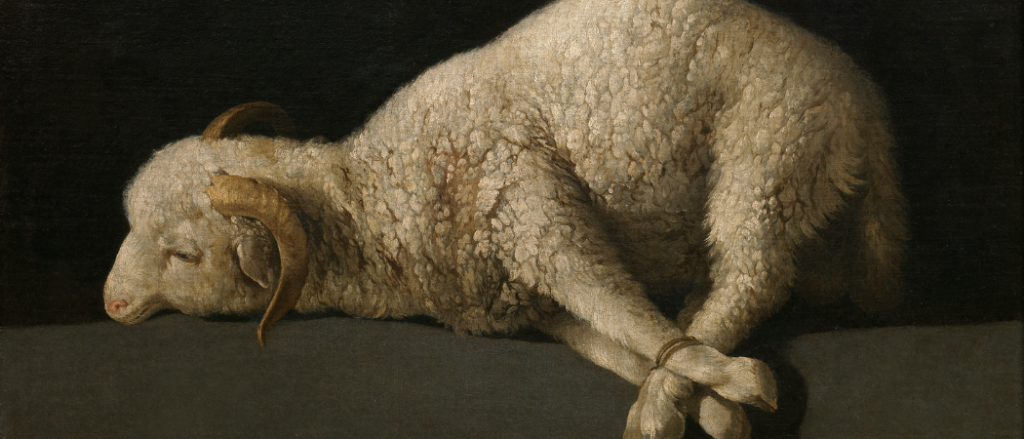
We remain in the season of Epiphany today, and we’re back in John’s gospel, celebrating that great moment when John the Baptist sees his cousin, Jesus, coming towards him and experiences a revelation of his own: ‘Behold, the lamb of God, who takes away the sin of the world!’
This is a season of revelation, when God opens our eyes to his presence in the world, when he comes to us and says, Look! Behold! See! The Lamb of God.
We’ll hear these words later in our Eucharist, urging us to pay attention and discern the presence of the Lord in the bread and wine. The priest will hold the Host aloft and awaken us with a revelation: “Behold, the lamb of God!” In this feast he is present to heal, to forgive, to unite us with himself, in loving relationship with the Father. He is present as our hope and our salvation.
I have needed this week to remind myself of God’s presence, and of the privilege of receiving this Word made flesh.
Many of us in the Church of England will have despaired of the headlines; I certainly have. After years of at-times quite rancorous arguing about how and even if the Church can pray for the blessing of same-sex couples, the House of Bishops finally concluded the process known as Living in Love and Faith. For many of us it comes not as a conclusion so much as a spectacular non-conclusion. The Church has authorised a few rather vague and inoffensive prayers that fall far short of affirming the depth of love, commitment and faithfulness that we know can and does exist between two men or two women just as it can between a man and a woman. At the end of all the wranglings, we received a few breadcrumbs, begrudgingly scattered.
You might also have read that the Charity Commission has given an official warning to the Diocese of Liverpool for the safeguarding failures surrounding the appointment of our previous bishop. What a mess that was! Few if any of us will ever know with certainty the details of what did or didn’t happen, but of this I’m certain: That the vulnerable and the victimised deserve a level of transparency, honesty and pastoral concern that the Church of England has failed to provide time and again.
In our despair, where do we look? I don’t know where else to look, but to the Lord, who makes himself present to us here today. ‘Behold, the Lamb of God, who takes away the sins of the world!’
If you’ve managed to avoid the C of E headlines—well done, I envy you!—it may be the national and international headlines that frustrate, distress or perhaps anger you. The looming spectre of war and conflict, the seemingly unending violence, both actual and threatened, the bitter divisions and suspicions imperilling even our own nation. Or it may simply be the circumstances of your own lives right now. The injustices you face, the anxieties that afflict your household, the relationships you wish could be repaired: with friends, with family. It may be the sins that so easily entangle you, that trip you up time and again.
‘I lift up my eyes to the hills; from where is my help to come? cries the composer of Psalm 121. ‘My help comes from the Lord,’ he answers himself, ‘the maker of heaven and earth.’ So today, in the midst of our own despair, we ask, ‘Where does my help come from?’ and John the Baptist answers: ‘Behold, the Lamb of God, who takes away the sin of the world!’
And sometimes it’s all we can say when others come to us in hopes of an answer to their problems. Helpless in the face of others’ suffering, we can only say with John the Baptist: Behold! Look! The Lamb of God!
Andrew heard those words and, as those first disciples were wont to do, instantly began to follow Jesus. Then he sought out his brother, Simon, and told him the good news: We’ve found the Messiah. They were previously followers of John the Baptist, but John, who knew the limits of his own calling and power, was only too willing to let them go and follow Jesus. He did not have the ability to transform these men, to lift them out of their circumstances; but he knew there was one greater and worthier than him, to whom he could only point the way, which he gladly did.
Behold, the Lamb of God.
Friends, I want to encourage you today to look to Christ as the source of your hope. He gives himself freely at this table. I have at times despaired this week of the institution I belong to, but what a joy to be able to return to the only true source of hope and salvation I know and to stand here and point to him, following John the Baptist and Andrew the apostle in saying, Look—I’ve found the Messiah!
Can I repeat to you the words I read on Christmas Eve? We remain in the season of Christmas until 2 February, by the way, so I’m within my rights. My tree is still sparkling away at home, and we’ve resolved to keep this tree standing for the rest of the season, as long as it doesn’t die on us. Here are those words, from the poet John Betjeman, and may they bring you hope today:
And is it true? And is it true,
This most tremendous tale of all,
Seen in a stained-glass window’s hue,
A Baby in an ox’s stall?
The Maker of the stars and sea
Become a Child on earth for me?And is it true? For if it is,
No loving fingers tying strings
Around those tissued fripperies,
The sweet and silly Christmas things,
Bath salts and inexpensive scent
And hideous tie so kindly meant,No love that in a family dwells,
No carolling in frosty air,
Nor all the steeple-shaking bells
Can with this single Truth compare —
That God was man in Palestine
And lives today in Bread and Wine.